I start from the title of this article to bring out the concept that the definition normality, has the effect of a veil over objective reality. With phrases such as “it is normal,” “everyone does or says so,” the ability to decide what is right or wrong has been delegated to the outside world, to the masses, losing common sense and the personal ability to discern. The phrase quoted in the title, “Meanwhile, children don’t understand,” has for generations justified attitudes and behaviors that deeply traumatized the childhood of our ancestors and ourselves.
And when this is validated, until 1976, by the fact that doctors themselves believed they could operate on newborns without anesthesia because they said they felt no pain, all this confronts us with the distance taken from life itself.

In the context of systemic representations, I have been concerned for years, with the effects on the body, nervous system and family system of this profound separation from life that arises as early as the gestation period, in the context of birth and the neonatal period. My experiences in Africa and the increasing assimilation in the systemic approach of Stephen Porges’ polyvagal theory and its applications in the context of somatic release at the body level, have led me to integrate into Jan Method – Systemic Representations to Vagal Regulation, the aspect of human physiology, of vagal co-regulation in the systemic context: we are an organism within a family organism.
The family organism should be a safe environment for the little one and the baby. If the collective culture leads to the belief that the child does not feel or understand anything, it is impossible to offer that creature a safe environment. The adult feels legitimized to become the executioner of his own children or even of other people’s children, to the extent that inwardly, in turn, because of the same traumas, he has had to freeze and inwardly die that child, that little girl.
Today’s knowledge and tools, allow us to stop this chain of traumatized, disconnected generations in survival mode. You can read my first three books to learn more about the context of gestation and birth; in this context, I will just bring back a profound message brought by Michel Odent, a French surgeon who brought attention back to the importance of physiological birth and the extreme attention that must be brought to the well-being of the mother and child.
To go deeply into the topic, however, I have to bring back some physiology cognitions to understand well the fetal and neonatal trauma aspect.
The autonomic nervous system is divided into parasympathetic and sympathetic. The parasympathetic, in turn is formed by the dorso-vagal branch and the ventro-vagal branch.
These two branches are part of two very distant evolutionary stages of human beings. The vagal dorsum, in common with amphibians and reptiles, appeared about 500 million years ago; the ventro vagal is its evolution, typical of mammals developing social relationships, developed about 200 million years ago. This evolution involved myelination of fibers. What is myelination? Imagine an electrical cable, with the wires conducting the current twisted together and the rubber sheath covering them; imagine the dorso vagal nervous system without the sheath and the ventro vagal with the sheath. It makes me think of the saying “bare nerve.”

With such an image, what can common sense bring to our minds? Perhaps that the uncovered nerve feels much more pain or that in any case the trauma enters much deeper than the one with the sheath, the myelin.
By way of background, the dorso vagal nervous system begins to form at the ninth week of gestation; myelination begins by the third month of gestation but is not complete until 24 months of age. The sympathetic is activated at birth and evolves as the infant learns to move. That said, it is logical to understand that the deepest traumas to be processed are gestational and neonatal period traumas. And that the deepest underlying fear in all of us is the same as a little fish hiding under a stone waiting for the predator to go away.
And it is on this basis that Method Jan works.
I met Michel Odent in 2019, the last seminar he gave in Trent in 2020, just before lockdown. He was ninety years old, now he is ninety-five and still giving his wisdom. One of the things that struck me the most and opened the door to a certain quality of work was when he shared about the socialization of childbirth.
It is assumed that this process began between the Paleolithic and Neolithic periods, approximately ten thousand years ago. Before that, the woman, like all mammals, following her instincts, at the time of labor would isolate herself to give birth. Birth was shrouded in an aura of mystery, in which, however, the undisturbed woman, in her physiology and with an unactivated nervous system, could release all the hormones functional for a physiological birth and I would add, equally sacred.
Then, someone, he wanted to look, to know, to spy.
And the observer affects the observed, simple law of physics. And in this case it also activated the nervous system, inhibiting the physiological processes already mentioned. From observing childbirth consequently became a ritualized and consequently socialized act. When Michel Odent brought this story, I understood many dynamics and today, after so long, a connection occurs to me.
Legends are always languages that carry hidden truths.
In 2018, in my first book, I reported a story, which I only now connect to Michel Odent’s words. His words connect back to the myth in which we find the drama of the socialization of childbirth.
I am of Scottish and Dutch descent, passionate about anthropology; I am familiar with the history of the Celts and the peoples before them who lived in Ireland, Scotland and Brittany. In Irish mythology, there are the tales about the Tuatha de Dannan, a people of demigods who lived in Ireland, before the arrival of the Celts, who lost the battle with the Milesians of Iberian origin and turned into the little people, elves and goblins in the mists of Ireland. There is one tale in particular that really struck me and that I find puzzling because of the similarities it brings to reality.
The goddess Macha, one of the daughters of the Tuatha, had married a farmer and became pregnant with twins. To save her husband’s life, she was forced by the king of Ulster, to race against his horses, despite the fact that she was on the verge of giving birth. Macha addressed the king and the crowd of spectators : “All you who are born of a woman, for the sake of your own mother, have mercy on me and let me give birth before I enter the race!”
All of them opposed his request.
Macha won the race but at the finish line, she gives birth to her twins before the eyes of all the men there, turning what was a sacred and secret ritual into her own public display amid insults and derision. With the twins in her arms, she puts a terrible curse on all the men of Ulster for their pride and insensitivity: for nine times nine generations (the most magical number there is), they would all suffer as in the pains of childbirth.
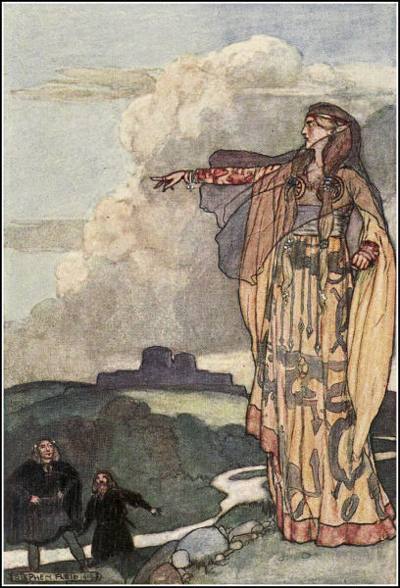
It is said that Macha’s curse has not yet ended.
I find in this narrative very deep aspects of the female rage that pervades women’s bodies and bellies, and it is interesting how this narrative brings us back to a great wound of the collective. The collective consciousness is remembering the importance of the relationship between mother and child, in gestation, birth and the early neonatal period.
Mothers hear, children hear everything, and may Macha’s curse be dissolved in freeing everyone: women, mothers and men, also children of mothers.
Sources:
“Polyvagal Experiences for Bodyworkers” Cinzia Brait and Marina Negri
“The Sacred Female” Maureen Coneannon.