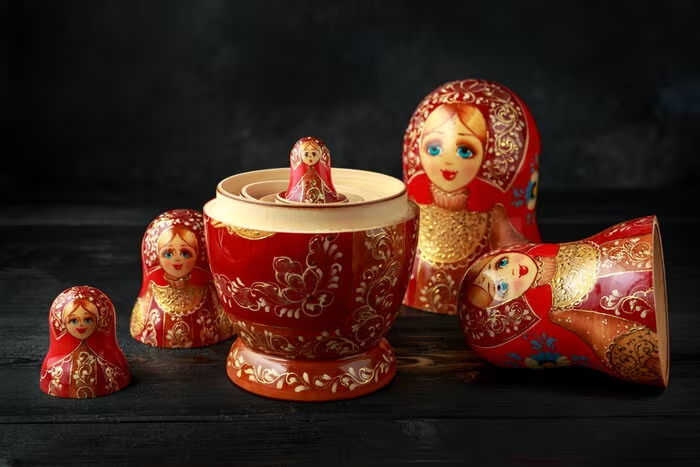
I use the term “Matryoshka effect” to refer to a dynamic that often occurs in my work lately.
We are in a very complex historical phase, which is revealing many hidden and at the same time resolving aspects with great possibilities for rebirth. In these years, the last direct witnesses of World War II are dying, and if we let them, they would close with their departure, the memory of the collective trauma they experienced directly. This cannot happen to the extent that we, their children and grandchildren, do not let them go and, in particular, do not let go of their stories and experiences, missing the opportunity to make room for the new.
Indeed, there tends to be guilt in allowing oneself to live a life in joy and abundance, when in fact, they would simply ask that we honor their sacrifices by allowing ourselves to fully experience the abundance of these present times.
Obviously, letting go involves the awareness of taking charge, an aspect that most individuals do not even realize they are entangled in their grandparents’ stories. The Covid period showed just such dynamics and responsiveness….
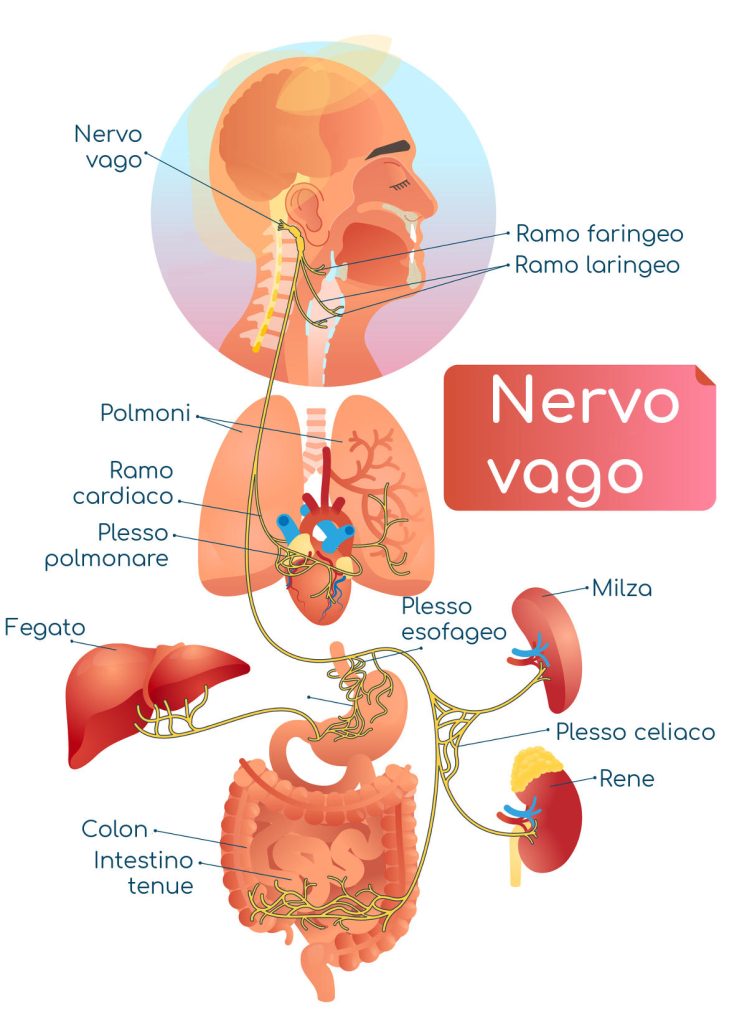
In addition, the issue shifts from the systemic plane, typical of the family constellations tool, to the traumatic aspect with the consequent activation of the sympathetic and parasympathetic nervous systems and the vagal reaction.
Stephen Porges’ polyvagal theory reframed what was known about the physiology of the nervous system so clearly that it can be integrated into many types of medical and psychological therapies and also in the holistic context.
In the work I propose, referred to as the Jan Method, the systemic aspect is becoming more and more deeply integrated with body-release trauma resolution, so much so that I sometimes find the definition of constellator limiting.
I have been working with nervous system activation for years, but my various experiences in Africa in recent years have led me to perceive and understand polyvagal theory in a completely different, integrated and experiential way. Africa deconstructs and brings us individuals, the children of a world defined as civilized, back to remember the basics of human physiology, especially with regard to what Porges calls enteroception, the ability to recognize basic needs: if I am hungry I eat, if I am thirsty I drink, if I am sleepy I sleep, and if I need to move, I do.
By freezing this from the time we were infants, in our deeply structured society in which, for example, breastfeeding a baby was not supposed to take place until four hours, despite the baby’s cries and demands, we lost touch with the reality of human physiology.
The consequences also manifest themselves at deeper levels of connections, affecting the ability to act and make decisions even as adults. To explain the matryoshka effect, which defines the traumatic effect at the transgenerational level tending to the female line in the family system, I have to give space to definitions taken from polyvagal theory.
The reaction of the sympathetic nervous system is based on the attack-escape movement. The distinguishing word for this activation is DEVO.
I have to make it, I have to survive, I have to keep going, otherwise I go crazy.
Obviously this is not on a voluntary basis but on an autonomous basis, of the nervous system in a threatened condition that is forced to freeze the emotional aspect and freeze the sense organs to some extent, activating resistance to increase the energy driven to action and attack-and-escape movement. The only emotion that remains is anger and then, once the emergency is over, anxiety.
Parasympathetic nervous system activation, on the other hand, is diametrically opposed. It is the most archaic, that of amphibians and reptiles: immobility. The key word for it is I CANNOT, which becomes “I pretend to be dead until the danger passes.”
Physically it is implemented by immobility, sluggishness, bradycardia, collapse, shutting down. The emotion that characterizes this state is sadness, associated with a deep fear of dying. These conditions are accompanied by a massive presence of hormones such as adrenaline, noradrenaline, and cortisol, which are basically addictive.
All of this we reproduce in the matryoshka effect and I use a story to explain it. All references are purely coincidental and taken from the experience of several sessions working on these issues.
I invite you in the reading to stay present; personal memories may be activated. In this case, breathe deeply and look around to make contact with your surroundings.
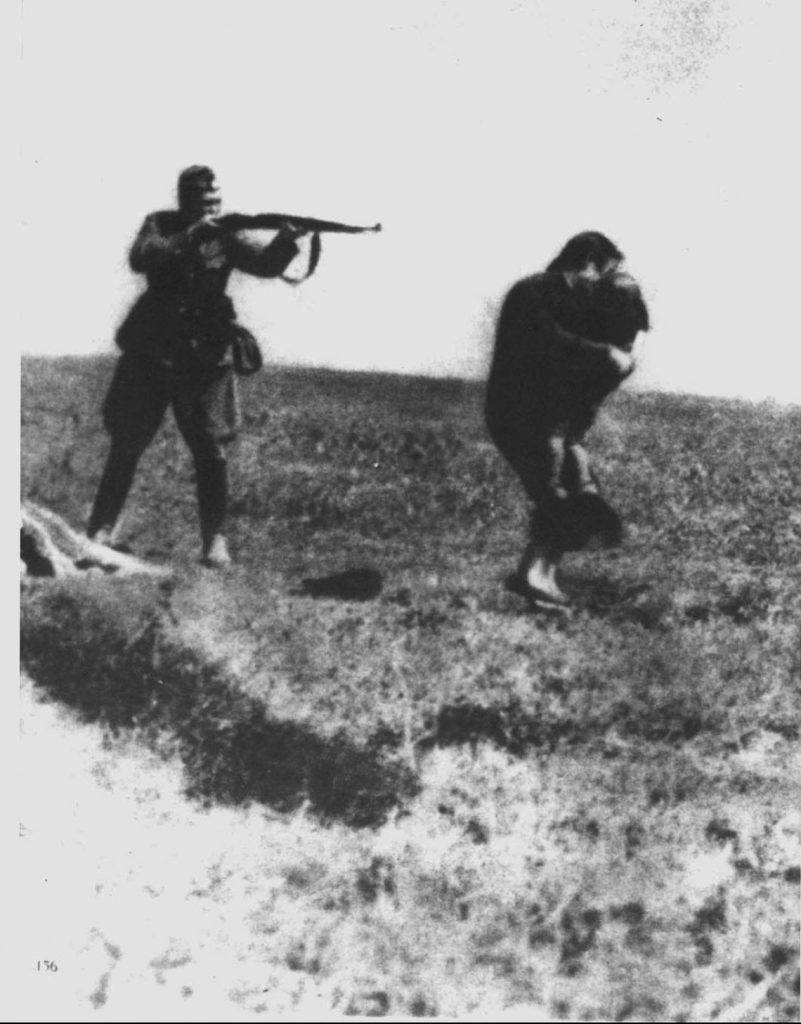
Grandma Maria was born in the countryside near the Piave River in 1918, at the end of World War I. She is already born with a nervous system activated by a frightened mother. The Spanish flu epidemic breaks out, followed by the rise of fascism and the figure of Mussolini. In the meantime she marries and has a couple of children before ’39 and a last daughter in ’44, in the midst of German roundups in their retreat as the Allies arrive. She is pregnant when a group of Germans burst through the door looking for her husband. They point their rifles at her, threaten her, push her, and then leave.
What happens?
It’s too much!!! If that woman felt all the fear and emotions of those moments, she would go crazy and probably lose the child she is carrying. This has happened to some women. Her guardian, the nervous system, in order to preserve life, activates the sympathetic autonomic system, freezes the heart, freezes the sense organs while the adrenals discharge adrenaline acting in attack and flight mode.
She snaps the DEVO and becomes one of those many women then called strong, unstoppable as tanks. She cannot feel love anymore, cannot produce oxytocin.
They are not strong, they simply resisted! It is profoundly different!
What about the creature in the womb? The embryo or fetus has not yet developed the cognitive aspect, it has no imagery to process and consciously. In the womb, its first home, it feels the mother’s heartbeat accelerating, feels the diaphragm and the enteric visceral nervous system, contracted and spastic in its movements, adrenaline in high amounts. In that womb she senses a threat that fills the whole womb.
It triggers the dorso-vagal branch, the CAN’T: paralysis, immobility, energy conservation to maintain major life functions. It is like putting yourself in the corner of the womb, shutting down and waiting for the danger to pass. The creature is born and is held by a rigid, contracted, trembling mother; the intonation of the voice that tries to be loving toward the daughter, however, is soiled by fear, by a state of anxiety. Moreover, it is not only the mother in that condition but the whole environment surrounding that family is on high alert in ’44; the collective unconscious is saturated with the fear of dying. There is no place to be safe.
That creature as pure as a crystal will be nurtured and consequently inhabited by the fear of dying.
That child grows up, the war ends and the economic boom breaks out: rebirth, desire to forget and move on but the nervous system remains activated, in the fear of death, in the fear of hunger, that there is not enough. Hunger for love and containment.
She marries, gets pregnant and has a daughter in ’65, in that social context of awakening and opportunity. In pregnancy, in transitions of condition, traumas resurface along with fears. That fetus in her womb, through hormones, will feel her mother’s fears, her emotions, the sense of abandonment given by a strong mother who endured wartime but had no time, being on the attack and flight, to be available, present and loving.
The time of loving care.
And it is in that vacuum that the third generation (ours) will tend to take over the mother and her emotionality, taking the place of the grandmother to nurture her with love and attention.
However, this generation experiences a major difference: it is born in a safe environment where there are no real dangers or threats.
And so it will be, that with one foot in the past and one foot in the present, the third generation, with today’s tools and at a sufficient temporal distance from the traumatic event, will have the opportunity to consciously acknowledge this, free themselves and liberate their mother and grandmother.
If a Matryoshka effect had been created, whereby the fears frozen in the grandmother’s womb held in different forms of nervous system activation, the daughter and granddaughter, it will be the latter who will instead be able to discern, to release in love and self-regulation, all that energy held back so that the grandmother can finally rest in peace, so that the mother can in her time die in peace and the granddaughter live in peace.
The war has been over for a long time!!!
Sources for polyvagal theory: “The Guide to Polyvagal Theory” by Stephen Porges and “Polyvagal Experiences for Bodyworkers” by Cinzia Brait and Marina Negri